How Personalized Account Based Marketing with Visual Content Boosts B2B Marketing Success
Personalized Account Based Marketing (ABM) combined with visual content also helps B2B businesses. This is how it works ideally.
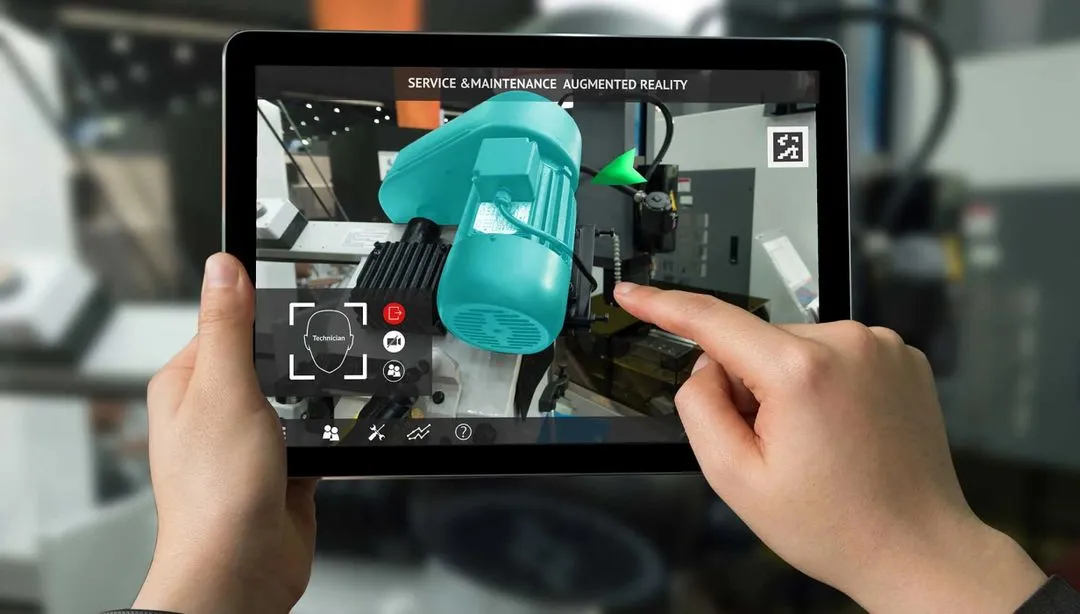
B2B companies need to look for innovative ways to effectively reach and retain their target customers. Account Based Marketing (ABM) has established itself in recent years as one of the most successful strategies in B2B marketing. When this strategy is combined with visual content such as 3D visualizations, a powerful synergy emerges that not only captures the attention of the target audience but also addresses their specific needs. In this post, we will highlight the advantages of personalized ABM with visual content and show how it helps companies assert themselves in a challenging market environment.
Why Account Based Marketing (ABM) is indispensable for B2B companies
Significance of ABM in B2B Marketing
Account Based Marketing (ABM) is a highly targeted marketing strategy that focuses on building and nurturing relationships with key accounts. Unlike traditional marketing approaches that target a broad audience, ABM specifically targets selected customers who are of particular importance to the company. This focus allows for deeper personalization and thus a higher success rate in lead generation and conversion.
Personalization is the key to success. In a study by ITSMA, 76% of respondents stated that ABM outperformed their marketing ROI because it allows them to create tailored messages and offers precisely adapted to the needs of their target customers. This precision makes ABM particularly valuable in B2B marketing, where purchasing decisions are often made by multiple stakeholders.
Current challenges for B2B companies
Skilled labor shortage and technological transformation: The integration of new technologies, such as automation and artificial intelligence, poses major challenges for many companies. On the one hand, these technologies open up new opportunities for efficiency gains, but on the other hand, they exacerbate the existing shortage of skilled workers. Companies must invest not only in technology but also in the further training of their employees to close this gap.
Economic uncertainties and inflation: Current economic conditions, characterized by uncertainties and high inflation, are putting a strain on many companies. These factors influence budgeting and often lead to cuts in marketing spending. Companies must therefore develop more efficient and targeted marketing strategies to remain effective despite limited resources.
Sustainability and market competition: The demand for sustainable business models is steadily growing. Companies that do not adapt their production processes risk not only losing market share but also losing the trust of their customers. At the same time, competitive pressure is increasing, which reinforces the need to stand out through innovative and differentiated marketing strategies.
The Power of Visual Content in B2B Marketing
Why visual content is crucial
Content and content marketing as a discipline have become an important part of B2B business, and this includes images and videos.
And visual content plays an increasingly important role in B2B marketing, especially when it comes to presenting complex products or services in an understandable and attractive way. 3D visualizations and CGI (Computer-Generated Imagery) offer the possibility to present technical products in a way that traditional 2D representations cannot. This form of visual content allows potential customers to experience products in a realistic and interactive environment, which facilitates decision-making.
An example of this are 3D models that give potential customers a detailed view of a product, including its functionality and areas of application. This is particularly important in industries such as mechanical engineering, automotive, or medical technology, where the complexity of products often presents a challenge for marketing. 3D animations and visualizations for medical technology are based on corresponding 3D models and help, for example, at trade fairs to explain the products in detail on site.
To actually display 3D models in 3D, the WebGL format is used, which enables photorealistic 3D views even on smartphones. And these also pay off in marketing performance: companies have achieved a conversion rate increase of up to 40% with it compared to traditional 2D content.
And integration into web environments is child's play.
E.g., with the free Model-Viewer as shown here with the example of a 3D model of a Doepke switchgear that RenderThat created:
Move the 3D object in all directions with your finger or mouse.
Use of 3D visualizations in ABM campaigns
3D visualizations can be used in ABM campaigns to specifically address the needs of individual target accounts. By adapting visual content to specific use cases or production environments, companies can make their messages even more relevant and convincing. This not only leads to higher engagement rates but also to faster decision-making and increased conversion rates.
A good example of this are personalized product presentations that are specifically tailored to the needs of an individual customer. Such presentations can be used in an ABM campaign to convince the potential customer of the product's benefits in their specific application.
How personalized ABM and visual content work synergistically
Personalization through visual content
The combination of ABM and visual content offers the opportunity to develop highly personalized marketing campaigns that are precisely tailored to the needs and interests of target accounts. Visual content created specifically for a particular company or even a specific person within that company increases the relevance of the message and improves customer loyalty.
Personalization can be achieved through in-depth data analysis and segmentation of the target group. For example, companies can use data from CRM systems to understand which products or services might be of interest to a particular customer, and then create tailored 3D visualizations that show these products in a context relevant to the customer.
Success factors for personalized ABM
Technology and automation play a crucial role in the successful implementation of personalized ABM campaigns. Tools such as marketing automation software make it possible to create and distribute personalized content on a large scale. This is particularly important when targeting multiple accounts simultaneously without losing relevance.
Important KPIs (Key Performance Indicators) that measure the success of such campaigns include engagement rate, conversion rate, and customer satisfaction. These metrics help companies evaluate and continuously improve the ROI (Return on Investment) of their ABM campaigns.
Practical Steps for Implementing ABM with Visual Content
Step-by-step guide to developing an ABM strategy
- Identification and segmentation of target accounts: Start by identifying the most important target customers who have the greatest potential for your company. Use data analysis tools to segment these accounts and develop a deep understanding of their needs. There are now numerous AI tools and service providers for this task, and even ChatGPT can achieve extremely good results.
- Development of personalized visual content: Have professional and, at best, photorealistic 3D content (3D visualizations, 3D product videos, Augmented Reality applications) created that directly address the challenges and goals of the target accounts.
- Integration into existing marketing strategies: Ensure that your ABM strategy is seamlessly integrated into existing marketing and sales processes. This requires close collaboration between the marketing and sales teams.
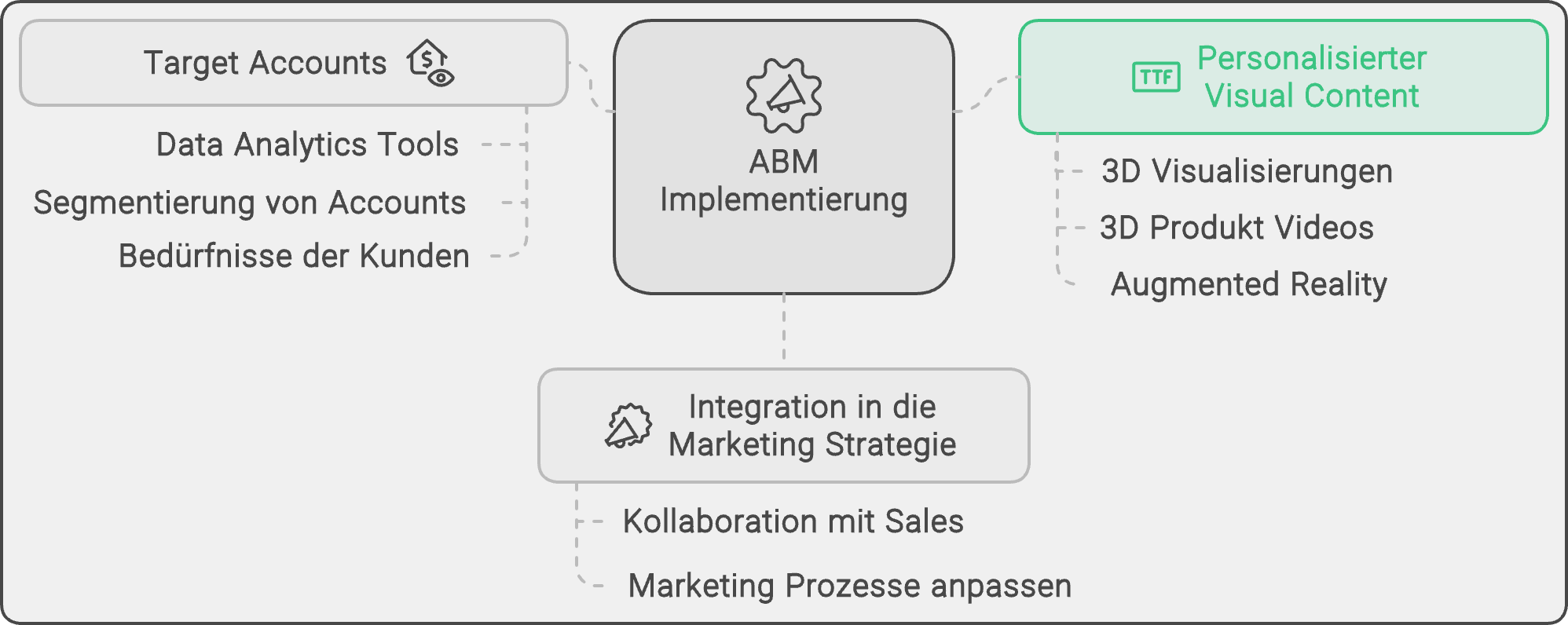
Integration into existing marketing strategies
ABM and visual content should not be viewed in isolation but as an integral part of the overall marketing strategy. This means that the created content should be used on various platforms and combined with other marketing activities such as email campaigns, webinars, and events. Tools such as CRM systems and marketing automation software can help efficiently manage this integration and ensure that the right message is sent to the right recipient at the right time.
Future Outlook: ABM and Visual Content in 2024 and Beyond
Technological trends that are changing ABM
Technology is evolving rapidly, and this trend will continue in the coming years. Artificial intelligence and automation will play an even greater role in ABM, enabling even more precise and effective campaigns. Especially in the area of visual content, technologies such as Virtual Reality (VR) and Augmented Reality (AR) will open up new possibilities to integrate customers into immersive experiences that facilitate and accelerate decision-making.
Sustainability and ethical marketing
Sustainability will continue to be a central theme in B2B marketing. Companies that successfully communicate their sustainability initiatives can gain a competitive advantage. Visual content offers an excellent way to present sustainable practices and products in a way that is both informative and inspiring. In the future, it will be crucial for companies not only to offer sustainable products but also to communicate them convincingly and authentically
daniel erning