The new Universal Commerce Protocol from Google – and why product content needs to be rethought now
The Universal Commerce Protocol (UCP) from Google lays the foundation for agentic e-commerce. The article clearly explains what UCP is.

E-commerce is on the brink of a fundamental change. Not because there is a new marketplace or another shop feature, but because the way people find, compare, and buy products is currently being restructured. Search queries are turning into dialogues. Product research is becoming consultation. And purchase decisions are emerging in the midst of conversations with AI systems.
It is precisely for this new reality that Google introduced the Universal Commerce Protocol (UCP) in early 2026: an open standard that makes commerce suitable for agentic, AI-driven experiences.
This article explains from the ground up:
- what UCP is
- why traditional product data and content are no longer sufficient
- what "agents" mean in the context of commerce and how we prepare ourselves as an ideal partner in this regard
The target audience includes marketing, e-commerce, and product managers in industry and retail who need to make decisions today that should still be valid in two to three years.
Why commerce needs a new standard
E-commerce systems have evolved historically. Product data is stored in PIM, prices in ERP, images in DAM, checkout in the shop, payments with third-party providers. This works – as long as the customer actively visits a shop and clicks through pages.
But that is exactly what is changing.
More and more purchase decisions no longer begin in the shop, but:
- in Google search
- in AI-supported assistance systems
- in dialogue-based interfaces like "AI Mode" or Gemini
There, users do not expect product lists, but concrete answers:
"Which product fits my use case?"
"Is it available in my region, within my budget, in my preferred variant?"
"Can I buy it right now?"
To enable this, it is not enough to provide a feed somewhere. A common language is needed, through which AI systems and corporate systems can communicate with each other in a structured manner.
This is where UCP comes into play.
What is the Universal Commerce Protocol (UCP)?
The Universal Commerce Protocol is an open, open-source standard that represents the entire commerce process – from product discovery to variants, prices, and availability, all the way to checkout, payment, and order management.
Importantly:
UCP is not a marketplace and not a shop system.
It is an abstraction layer that connects existing systems.
One can think of UCP as a common grammar for commerce. Instead of building a separate integration for each platform, there is a standardized way to provide capabilities:
- Discover products
- Create shopping carts
- Trigger checkouts
- Apply discounts
- Process payments securely
This massively reduces complexity on the corporate side – and makes commerce truly agent-capable for the first time.
What does "agentic commerce" mean?
The term "agent" sounds abstract but is easy to explain.
An agent is an AI system that acts on behalf of a user. It not only responds but takes on tasks. For example:
- Research products
- Compare alternatives
- Check availability
- Calculate prices
- Prepare or trigger purchases
Instead of the human clicking every step themselves, they delegate the goal and context to an agent.
For this to work, the agent must understand:
- what a product is
- what variants exist
- for which use cases it is suitable
- how it can be purchased
UCP provides the technical foundation for this. The agent discovers through standardized profiles what capabilities a company offers and can use them securely – without individual custom solutions.
Why product content becomes a key resource
Technically, UCP solves many integration problems. Strategically, however, it shifts something much more important: the value of product content.
In agentic commerce experiences, it is no longer enough to "represent" a product. Content must be:
- machine-readable
- context-capable
- variant-capable
- target group-specific
- market-compliant.
An agent can only recommend what it understands. And understanding means not just dimensions and prices, but:
- Use scenarios
- Differences between variants
- Visual features
- Emotional appeal
- Relevance for a specific situation
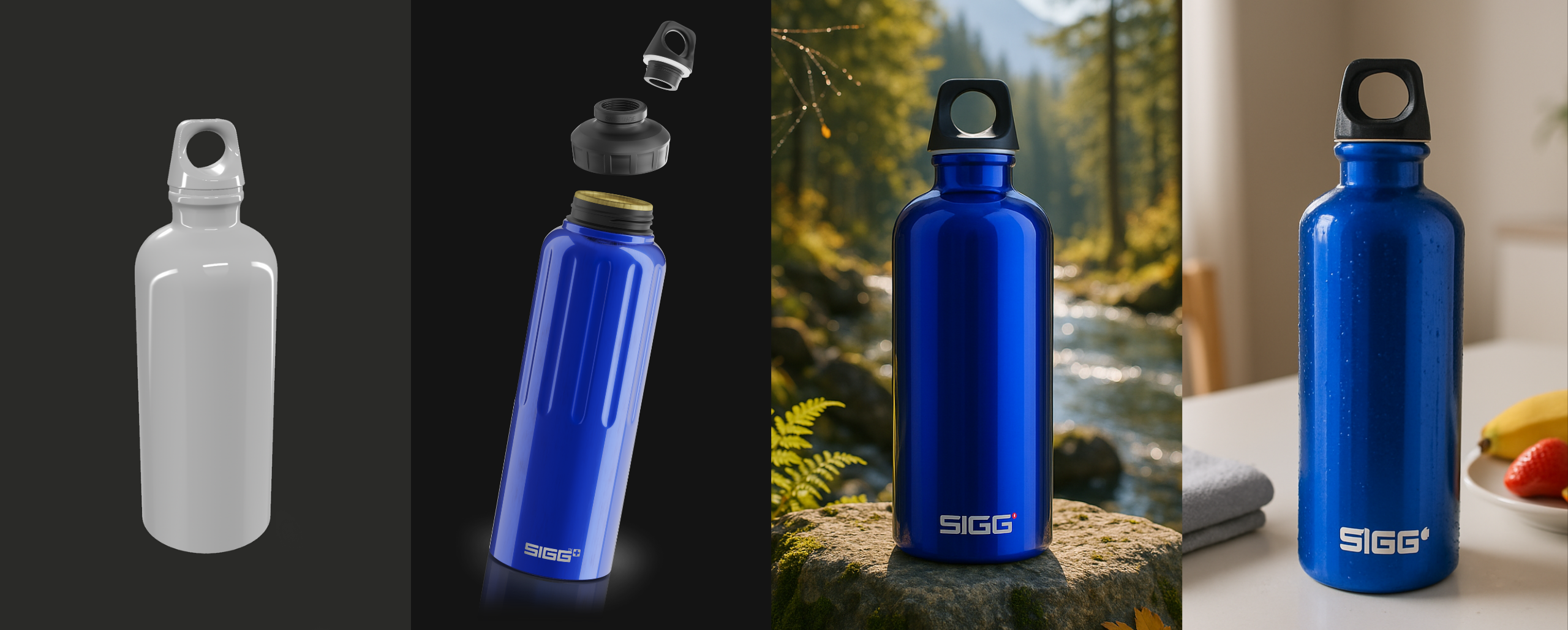
This means: product images, visualizations, scenes, animations, and metadata are not just accessories, but functional components of the commerce flow.
The challenge for industry and retail
Especially traditional industrial and retail companies face a structural problem:
- large portfolios
- many variants
- international markets
- limited budgets
- long content timelines
Traditional photo production does not scale for this. And manual content maintenance even less so.
UCP intensifies this pressure because content must no longer just be "nice," but situationally retrievable, combinable, and automatically usable.
This is exactly where RenderThat comes into play.
Why RenderThat is an ideal partner for UCP
RenderThat generates visual product content that is not created in isolation but is systemically thought out from the beginning.
Products are once digitally built cleanly – as digital twins – and can then be:
– varied at will
– localized for different markets
– embedded in new use scenarios
– visually and content-wise recombined
This is exactly the kind of content logic that agentic commerce needs.
Scalable digital product representation as a basis
Our core competence – scalable rendering of large portfolios – creates a stable foundation to provide products consistently, up-to-date, and machine-capable. A product no longer exists as a single image but as a content system.
The RenderThat HUB as the control center
With the RenderThat HUB, we already centrally manage data, variants, approvals, and assets today. This structure can be adapted to UCP standards in the future, allowing product information and visuals to be generated and delivered directly with AI support.
Content Flow for contextual experiences
Our content flow engine combines existing visualizations with AI-supported image generation. This results in:
- market-appropriate lifestyle scenes
- target group-specific image worlds
- variant-dependent visuals
Exactly what an agent needs to show a user the right product in the right context.
Experience with agents and workflows
We are already working today with AI agents that access production and content workflows. This know-how can be directly transferred to agentic commerce scenarios – from content briefing to automated delivery.
What this means concretely for companies
UCP will not replace e-commerce overnight. But it will fundamentally change it. Companies that start early to build their product data and content in a structured, scalable, and agent-capable way will gain a massive advantage.
It is not about overhauling everything tomorrow. But about:
- Understanding product content as a strategic asset
- Creating digital twins instead of individual assets
- Preparing systems that can communicate with AI agents
Our conclusion
The Universal Commerce Protocol is more than a technical standard. It is a signal of where commerce is heading: away from isolated shops, towards contextual, AI-driven purchase moments.
Product content thus becomes the connecting element between brand, system, and user. And this is exactly where RenderThat’s strength lies.
We look forward to engaging with companies that want to start preparing their digital presence for this new reality today. UCP will play a central role in the future of e-commerce – and we are convinced: those who invest now will not have to catch up later.
If you are curious about how your product world can become UCP-capable, contact us.
As a further resource, we recommend the official article from Google:
https://developers.googleblog.com/under-the-hood-universal-commerce-protocol-ucp/
david wischniewski